Monday, 28 March 2016

Faulty communications along U.S.-Mexico border are AmericaĆ¢€™s blind spot

We all know that mission critical communications are vital 24 hours a day and as this article shows that even a tiny lapse in communications can lead to chaos. Even the U.S government can’t keep their radio communications up-to-date on one of the most watched borders in the world, as we can see from the article below.


Put yourself in the shoes of a U.S. Border Patrol Agent. You are patrolling the U.S.-Mexico border, driving through desolate terrain, and in the distance, you spot movement. You head toward a deep ravine and step out of your vehicle when a shot rings out and you hear the zip of a bullet speeding past your head. With training and instinct, you dive for cover and draw your weapon, reaching for your handheld radio.


And the radio doesn’t work.


There’s no one to call, because you are in one of the many areas of the southern U.S. border that has no radio coverage. Out there in the ravine is a drug cartel “rip crew,” heavily armed and firing on your position, bullets punching into your vehicle until smoke is rising from the hood. If they come closer, you are outnumbered. If they flee, your vehicle is disabled, and they will disappear into the vast emptiness along the southern border, where they will likely fire on one of your fellow agents, should they encounter them.


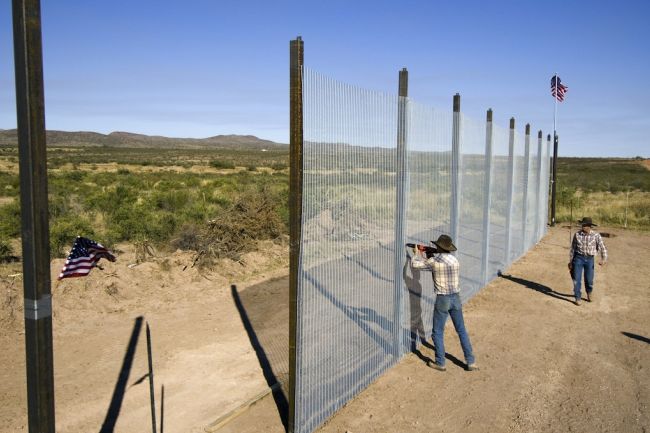
That is the state of communications along many of the areas on the U.S.-Mexico border. When the U.S. Border Patrol needs it the most, they cannot communicate with anyone. With rising threats and political propositions, U.S. border security has again risen to the top of the public consciousness. There are calls for more border patrol officers and stronger fencing, for aerial and ground based vehicles and other technology. But the lifeblood of the border security apparatus is communication, and in some areas, communication is not possible.


“If there is one thing in securing America’s borders that hasn’t changed since September 11, 2001, it’s the inability to resolve the communications lapses and gaps along the border,” said Ron Colburn, the former National Deputy Chief of the U.S. Border Patrol. “Here we are almost 15 years into this, and we still have not addressed this problem.”


One reason 343 New York City firefighters died when the World Trade Center buildings collapsed was that their radios could not communicate with the emergency responders outside the buildings, who were warning the structures were about to come down. The recommendations of the 9/11 Commission cited the need to create interoperable tools that allow first responders and law enforcement to communicate in the most unforgiving of environments.


And there are few environments less forgiving than the nearly 2000-miles of the U.S.-Mexico border.


Recognizing this, the Department of Homeland Security (DHS) launched a massive project to improve the communications capacity of officers along the U.S. border. It failed. In March last year, the U.S. Government Accountability Office (GAO) reported that $945 million in taxpayer funding used to build radio towers and upgrade radio equipment has yielded little benefit and in some cases does not work as well as what Border Patrol agents were using before. The effort cost too much and was taking too long.


Colburn said that the state of communications today means U.S. Border Patrol cannot call for support in some areas. They cannot feed information from the field into the intelligence food chain, and they cannot receive images from manned or unmanned vehicles to know whether they are walking into an ambush or encountering a group of friendly forces.


Likewise, Border Patrol agents cannot communicate easily with other law enforcement agencies (like a local Sheriff’s office), nor can those law enforcement agencies run on-site biometric checks (e.g., fingerprints) of individuals they suspect may have recently crossed into the United States illegally.


“I see it in the eyes and hear it in the voices of the men and women of the Border Patrol,” said Colburn. “They understand the mission and they want to accomplish it, but they feel like they have been abandoned.”


Answering the Unanswered Question


Most Americans own a smartphone, which is a powerful piece of technology. Experts say it’s hard to understand how, in this age of technological innovation and advancement, the United States is not arming its frontline officers with the very basic capacity to talk to one another.


Part of the challenge is that we have not brought new solutions to this long-standing problem.


To advance the effort, the Border Commerce and Security Council (of which I am Chairman and CEO) helped bring multiple stakeholders to the table in December last year in Cochise County, Arizona, to see if an innovative application of several integrated technologies could solve these communications challenges. It was a Proof of Concept test that included the U.S. Border Patrol, the Cochise County Sheriff’s Office and a group of businesses with tools that can address a range of communications and intelligence challenges. What was tested is called the Field Information Support Tool (FIST).


FIST started in 2006 as basic research at the Naval Postgraduate School (NPS). NPS Information Sciences Research Associate James Ehlert said in 2010 that the goal was to create “an easy-to-use, inexpensive hand-held solution to achieving communications interoperability and a common physical and human terrain operating picture for both on-the-ground field collectors and tactical decision makers.”


The research question was, how can we use modern technology to allow officers in the field to talk to one another and to their superiors while also collecting and then acting on real-time intelligence?


“The intelligence aspect is that the local and federal law enforcement officers need to look at things from a risk-management perspective,” said Brian Conroy, Business Strategy and Strategic Development Manager at NOVA Corporation, which works with Kestrel Technology Group, the company that has produced the FIST system. “They need to find the high-risk areas [along the border], and if you have a tool that collects data and runs algorithms against it, you can conduct risk assessment and trend analyses. Human intelligence contributes to a holistic common operating picture.”


This is what the FIST system achieves, and it’s what was seen during the proof of concept test. In general terms, FIST uses off-the-shelf communications tools (like an Android device) to gather intelligence from officers on the front lines. With these tools, officers feed information into a larger database compiled from a variety of sources (including other officers) that informs strategic and tactical decision making. This is then passed back to the people working along the border.


The need for this kind of tool is obvious, but it has only been recently that the right technologies and software were put together in a way that makes it possible.


Moving to the Market


Over the last year, there has been a push to transition FIST into the marketplace. Research transition is tough, as DHS has found in many cases over the years. Unlike other agencies and components, such as the military branches, the homeland security and law enforcement marketplace is heavily fragmented and with limited resources. It makes it difficult to take good, workable ideas from prototype to production. As big of a challenge as creating an innovative piece of technology is finding a way to produce it in line with operational and funding realities. A local Sheriff’s office, for example, does not have an endless amount of funding and time to bring in expensive technologies and then train deputies to use them. For that matter, neither does the U.S. Border Patrol.


What’s needed is a simpler, cheaper solution, and based on the proof of concept testing, FIST appears to be that solution.


“It’s ideal for smaller law enforcement agencies because it can unify operations and reporting and scale capability, creating a force multiplier,” said Ivan Cardenas, technical director of the Kestrel Technology Group, which is helping to bring FIST to market. “It is a sophisticated system, but it is easier to use than the complexity suggests.”


There are a few moving parts here. There are applications that allow off-the-shelf technologies to record and report intelligence, such as the location of a breach in the border fence or evidence of people moving through the rugged terrain. There are existing law enforcement and Border Patrol network capabilities (or cloud-based tools) that store that information. The secret sauce, however, is the complex digital architecture that allows real-time control and fusion of multiple information sources in a way that supports the mission. This is the one thing that has been missing from the border communications and intelligence efforts, and it’s why DHS has struggled to address the challenges to this point. The innovation is in the complexity, and FIST makes it simple.


Of course, that complex innovation is for naught if the agents in the field cannot transmit and receive intelligence. Enter SiRRAN Communications, another stakeholder at the proof of concept test in Arizona.


“We often forget that without network access, we’re blind,” said SiRRAN’s Director of Sales Mark Briggs. “Our technology brings that cell network to anywhere that it is needed.”


Briggs describes this technology as a portable, battery powered cell network—a network in a box. It creates a local, closed network that any agent within range can access to communicate and record intelligence. The unit provides local communication in areas where there is no coverage, and if there is no way to access the communications grid, it captures intelligence and transmits it to the larger repository as soon as it finds a signal.


The lesson here is not just that FIST is a workable system to satisfy the mission needs of America’s border security and law enforcement professionals. It’s also that the answer to the communications challenges along the border will not come in the form of $1 billion worth of cell towers built under DHS management. If it were, we would have solved this problem by now. The fact that we have not reveals that the ultimate solution is necessarily complex and multifaceted while also being easy to use and in-line with realistic operating budgets.


Perhaps the most important lesson, however, is that there are real tools that our Border Patrol and law enforcement officers could be using. Right now there are thousands of men and women on the border, and until we give them the tools they need to do their job, it will make border security and the safety of our frontline heroes difficult to sustain.

Saturday, 19 March 2016

The obituary of Batgirl actress Yvonne Craig

Yvonne Craig, the actress best known for her role as Batgirl in the 1960s Batman TV series, has died aged 78.


Appearing in the third and final series of the iconic, multicoloured adventure spoof, Craig’s portrayal of Batgirl was every bit as charming, self effacing and fun to watch as her on-screen co-stars Adam West and Burt Ward.


The creation of Craig’s iconic role was a rare example of synergy between the disparate words of television and comic book fiction. In the comics, a character called Bat-Girl (Betty Kane), who was designed as a love interest for Robin, had appeared at the beginning of the decade, but been abandoned by the series creators just a few years later. However, the new version of the character (this time with the civilian identity of Barbara Gordon), created by DC staffers Gardner Fox and Carmine Infantino (at the request of editor Julius Schwartz and Batman producer William Dozier), was fresh, funky and fun, as well as an instant hit with the fanbase. The new Batgirl debuted in the comic books in January of 1967 and then in the TV show later that year.


Although the series was cancelled after season 3, Batgirl became an icon of 60’s television, as well as an integral part of the comic books, her four colour character formed, at least in part, by the spirited performance of Yvonne Craig.


The role came to define Craig and, in later years, she would admit to being surprised by the show’s enduring popularity.


“I really didn’t think we were making Gone With the Wind,” she once said. “Just an episodic TV series that would be over when it was over and then it would never rerun again”.


Instead, millions of people around the world enjoyed Craig’s performance, especially young girls, many of whom saw the character as a brave, empowering figure in an era typified by submissive female roles in film and television.


Craig was comfortable, if slightly demure, about being a role model. When asked about the subject later in her life, she simply said, “I meet women today who tell me that they grew up viewing Batgirl as an important role model. If they choose to know me in that context, well, I’ll take it.”


Initially trained as a ballet dancer, Craig worked at The Ballet Russe de Monte Carlo and used her skills as a dancer to perform most, if not all, of her own stunts as Batgirl.


Away from Gotham City, Craig also acted alongside Elvis Presley in two of the singer’s movies, It Happened At The Worlds Fair (1963) and Kissin Cousins (1964). She appeared in the third season of Star Trek as Marta, the Orion Slave Girl from Series 3’s Whom Gods Destroy and portrayed a ballerina in Austin Powers favorite movie In Like Flint (1967).


A prolific TV actress, Craig also appeared in episodes of The Man From U.N.C.L.E, The Wild Wild West, My Favorite Martian, Wagon Train, It Takes A Thief, Kojak, The Six Million Dollar Man and Starsky & Hutch, amongst (many) others.


In later life, Craig worked as an estate agent and then made a living in the prepaid phone card business, however she didn’t give up acting entirely and is perhaps best known by younger fans for lending her vocal talents to the Nickelodeon cartoon series Olivia.


In a heartfelt statement to Yvonnes many fans, Craigs family praised her resilience, sense of humour, business acumen and charity work. She will be missed.

Saturday, 20 February 2016

Comprehending The Essentials of a 2 way Radio Antenna

An antenna is essentially the most crucial element of a two way radio and other transmitting application such as cell phones, television, radar, or satellite communication. It is responsible for performing the most important task – converting electric power to transmittable radio waves and the other way round.


How an Antenna Works


To transmit a signal, the transmitter provides an electric charge that oscillates at a specific radio frequency to the terminals of the antenna. Consequently, the antenna sends out corresponding electromagnetic waves. During reception, the antenna takes some of the power of the transmitted electromagnetic waves to generate an extremely small voltage for the terminals, which is then redirected to a receiver that amplifies the signals. This is basically how an antenna works.


Extensive Applications


The applications supported by an antenna go beyond communication. The same concept powers today’s high tech wireless applications that run computer networks; Bluetooth enabled systems, garage door openers, and baby monitors. It’s important to know that a perfectly functioning antenna is not only critical to the functioning of your two way radio ; it also helps maintain the life or longevity of your equipment.


The Bigger, The Better


The first and most important rule of thumb about an antenna to keep in mind is that the taller it is, the higher your db gain. A high volume of db gain is critical to achieving a stronger reach and better performance of your two way radio equipment. This basically translates to, “the bigger, the better.” However, in order to achieve results in practical situations, the antenna can have only so much height. In essence you have to sacrifice convenience for performance or vice versa. You can’t walk around or even install a gigantic antenna for all your needs, say for example your car radio.


Positioning of Antenna


The second rule of thumb pertains to the positioning of your antenna. The most optimal position for then antenna would be the centre of your metal car roof. In situations where this is not possible, you would need a “no ground plane” antenna. A no ground plane is basically just a metal surface that goes around the base of your antenna so that you have something for the radiating signal to react with. The next aspect you need to consider for your antenna is the frequencies at which you would be transmitting on. A VHF radio transmits and receives in a range from 136 to 174 MHz.


Chubby and Long Antennas


There are different kinds of two radio antennas available depending on how you want to use it. The large stock antenna is powerful and can be replaced or upgraded as you require. The shorter or stubby antenna provides a great deal of convenience. You can add a longer whip antenna to enhance your range. When it comes to two way radios, you stand to gain a great deal of advantages by having a business radio that comes with a removable antenna. The one problem is that removable antennas may not necessarily be compatible with all kinds of radios.

Thursday, 18 February 2016

Radio spectrum allocated for global flight tracking

This very simple, very easily executable solution to a problem that is growing. The Frequencies are already allocated to the airline industry and a simple piece of equipment (non expensive) can be installed. You can find the full article here.


The International Telecommunication Union (ITU) has allocated radio spectrum for global flight tracking for passenger aircraft using satellite-based systems.


The move follows developments spurred by the so far unexplained disappearance of Malaysia Airlines Flight 370 in March last year, which prompted the aviation community to look into possibilities of constant monitoring of passenger planes in flight.


The frequency band of 1087.7-1092.3MHz has been allocated, which is already being used for data transmissions between planes and terrestrial stations that are within the line of sight.


Extending the system to cover also communications between planes and satellites and satellites and terrestrial stations will enable creating a complex system capable of tracking passenger planes throughout the flight even over oceans and remote areas.


The ITU agreed on the allocation at its 2015 World Radiocommunication Conference following a call by the International Civil Aviation Organisation (ICAO).


Performance criteria for satellite reception of the signals will be established by ICAO.


“In reaching this agreement at WRC-15, ITU has responded in record time to the expectations of the global community on the major issue concerning global flight tracking,” said ITU Secretary-General Houlin Zhao. “ITU will continue to make every effort to improve flight tracking for civil aviation.”


ITU has been working on standards to facilitate the transmission of flight data in real time since early after the MH370 disaster.


Already in April 2014, less than a month after the aircraft’s disappearance, Malaysian Minister for Communications and Multimedia called upon ITU to address the issue.


“The allocation of frequencies for reception of ADS-B signals from aircraft by space stations will enable real-time tracking of aircraft anywhere in the world,” said François Rancy, Director of the ITU Radiocommunication Bureau. “We will continue to work with ICAO and other international organizations to enhance safety in the skies.”


In October 2014, the ITU Plenipotentiary Conference meeting in Busan, Republic of Korea, instructed WRC-15 to consider global flight tracking in its agenda.


Friday, 5 February 2016

Some Thoughts On... The Sony TV & HiFi Over-Ear Wireless Headphones

I don’t care who knows it; I still think wireless headphones are cool. Like bowties, or fezzes in that respect. Oh sure, there are drawbacks, sacrifices that must be made, but its still a total novelty to take a conference call whilst standing up and wandering around.


I don’t know about you, but I think better on my feet. That’s why I’m crap at job interviews, because I appear far more nervous than I actually am, due to all the squirming I do. In reality, if I could just stand up and pace around the room at will, well, you’d probably be reading this article as-written by someone with far greater knowledge and experience.


And get this, the Sony Over-Ear headphones have a 100m listening range. That means that it should be entirely possible for you to get up and make yourself a cup of tea whilst still listening to…Whatever it was you were listening to that was so riveting that it made you crave caffeine in the first place. Feasibly, you could even venture outside to yell at the local kids, or pick up the paper.


Also, with these headphones, you’ll get 28 hours out of a AAA battery, now you really can’t say fairer than that, can you? Especially if you charge it up when you’re not using it.


They are big though. Like, really big. Instead of being built for regular, Human-size heads, they appear to have been sculpted with Red Dwarf’s resident mechanoid Kryten in mind (two BBC Sci-Fi references in one article? Bonza!), the sheer size is ridiculous. They are adjustable, of course, but you might still have every cause to wish these headphones were smaller.


Another negative is the sound quality. I don’t want to say that it is bad (of course, there’s a ‘but’ coming…), but there is a low hiss that seems to permeate everything that you hear, as well as a loud cut-off noise if the signal is broken in any way. From a design perspective, this second feature makes a lot of sense, you don’t want to be outside, waffling away to your mate and not notice that the signal has dropped out (as happens so often with mobiles), but still, there simply has to be a better way, doesn’t there? The noise is loud, intrusive and actually rather scary at times.


However, apart from those minor, nagging problems, these headphones are actually quite nice. They sound OK, the wireless function works beautifully and the price is alright as well. Nice one, Sony.

Tuesday, 2 February 2016

ETRI presents a blueprint of the 5G Future

We will see a huge change in the way we access the the internet in the future when 5G is here, at speeds that only big businesses and high level internet companies see at the moment, we will have this to hand on our smart phones and tablets. When 5G is hundreds of times faster than any of the UK’s broadbands, households will be looking to the mobile phone companies to supply their home broadband.


A 5G future is no longer a distant one, but an upcoming reality. High quality videos of more than 10Mbps can be served simultaneously to 100 users even in a train running at up to 500km/h. People can experience data rates that are 100 times faster than currently available technologies.


The Electronics and Telecommunications Research Institute (ETRI) of Korea will hold a “5G technology demonstration” on the 18th December, 2015. It will demonstrate future SNS (social network service) and several 5G core technologies such as “millimeter wave”, “Mobile Hot-spot Network”, “in-band full duplex” and so on.


5G is the next generation wireless technology that would provide even faster data rates, even lower delays, and even more devices connected than 4G. Accordingly, distinct and differentiated applications are expected in 5G.


ETRI’s “future SNS” is a kind of trial service model to apply 5G technologies that provides dynamic user-centric connection to neighboring people, things and spaces. It is characterized by instant content-sharing between users, communication with neighboring things, and Giga-bps(Gbps)-grade video applications in vehicles.


5G core technologies demonstrated by ETRI include the following:


— MHN (Mobile Hot-spot Network) is a mobile backhaul technology that provides high-speed Internet access of Gbps in vehicles at speeds of up to 500 km/h (e.g. KTX in Korea). Almost 100 passengers can watch videos of high quality simultaneously.


— ZING is a near-field communication technology that enables mass data to be transmitted with 3.5 Gbps data rate between neighboring devices within the radius of 10cm.


— Single-RF-Chain compact MIMO technology enables a single antenna to simulate the effect of multiple antenna. It can reduce antenna volume and cancel inter-antenna interference in a multi-antenna system.


— Millimeter wave (mmWave) beam switching technology provides fast switching of radio beams to mobile users, and therefore allows seamless Gbps-grade service in mobile environments.


— Mobile Edge Platform (MEP) is a mobile edge cloud server on vehicles that enables passengers to enjoy customized Gbps-grade content and connects them with neighbors, things and spaces. It provides user-centric services.


— In-band Full Duplex technology can transmit and receive signals simultaneously over the same frequency band. It can increase spectral efficiency by up to two times.


— Small cell SW technology is designed for AP(Access Point)-sized small cell base stations that can reduce communication dead zones and improve data rates per user in a hot-spot area.


“With this demonstration event, we are officially introducing our R&D results on 5G. We will continue to lead the development of 5G technologies. Also, we are trying to develop commercialization technologies needed by businesses, and to construct a 5G ecosystem.” said Dr. Hyun Kyu Chung, vice president of ETRI Communication & Internet Lab.


In January, 2016, ETRI will demonstrate Giga internet service and future SNS in a Seoul subway train installed with MHN and ZING kiosks. ETRI will also introduce hand-over technology on a millimeter wave mobile communication system and 5G radio access technology that satisfies 1 millisecond radio latency.


About ETRI


Established in 1976, ETRI is a non-profit Korean government-funded research organization that has been at the forefront of technological excellence for about 40 years. In the 1980s, ETRI developed TDX (Time Division Exchange) and 4M DRAM. In the 1990s, ETRI commercialized CDMA (Code Division Multiple Access) for the first time in the world. In the 2000s, ETRI developed Terrestrial DMB, WiBro, and LTE-A, which became the foundation of mobile communications.


Recently, as a global ICT leader, ETRI has been advancing communication and convergence by developing Ship Area Network technology, Genie Talk (world class portable automatic interpretation; Korean-English/Japanese/Chinese), and automated valet parking technology. As of 2015, ETRI has about 2,000 employees where about 1,800 of them are researchers.

Teleprompters and earpieces are changing theatre, and not necessarily for the better

This article was originally posted on thestage.co.uk and they highlight that the use of earpieces for prompting actors is increasing, this very simple technology used in this way makes people uncomfortable. But why? Earpieces these days are so small that people standing really close to the wearer would have literally be standing on top of them to see it, let alone be 15m away. Maybe it’s the thought that the actor should be able to remember their lines? or that bringing undue technology into the theatre would decrease the value of it?


Car crash theatre. That’s how a colleague described Al Pacino’s return to the Broadway stage in David Mamet’s new play, China Doll.


For those who may not have been following the story, Pacino’s return to Broadway has been blighted with problems – most notably, reports that he cannot remember his lines. Teleprompters have been installed around the stage and Pacino wears an earpiece, even after the production’s opening was delayed.


Pacino is not the only star on Broadway this season getting help with his lines. If reports are to be believed, Bruce Willis in Misery is also being given a helpful prompt or two through an earpiece, as are Cicely Tyson and James Earl Jones in The Gin Game.


However, Pacino seems to be the main focus of press criticism and a large part of me feels sorry for him. Undoubtedly, he is under intense pressure – despite past success on Broadway, he is in danger of being remembered best, if not most fondly, for China Doll.


The sign outside the Schoenfeld Theater quotes a line from Pacino’s character in the play: “Can you just tell me what’s happening?” In the circumstances, it seems both ironic and ill-judged. Meanwhile, around the corner at the St James Theatre, the comedy musical Something Rotten has put up a cheeky, if somewhat venomous, sign on its canopy, saying: “All actors promise to memorize most of their lines”.


For any actor, it is terrifying to think that one day, no longer being able to remember your lines, you may not be able to work. The interesting point about this situation is that the media have been far more forgiving of other actors: Tyson and Jones have been treated as beloved national treasures. At 90 and 84 years old respectively, they have a few years on 75-year-old Pacino and therefore it’s may be understandable that they require prompts. A similar response greeted Angela Lansbury who, in Blithe Spirit on Broadway and in the West End, wore a cleverly designed hat which incorporated ear pieces.


Despite criticism of Pacino’s use of prompting devices, China Doll has not seen a slump at the box office. Audiences seem to be happy to pay top-dollar ticket prices to see their favourite stars on stage whether they know their lines or not. Does this mean we accept that teleprompters and earpieces will become inevitable in theatres? Has a precedent now been set for Hollywood actors to slip into a play during a gap in their moviemaking schedules believing they don’t need to spend time learning lines? Will audiences continue to tolerate this because of that star’s status and the opportunity to see them live?


I hope not: knowing lines is a fundamental skill in the craft of acting. I want to see star actors on stage but I also want to see and remember them at their best. And the reporting of apparent production problems does nothing to help a theatre industry already faced with an audience which may expect or hope for a disaster on stage to tweet about; the resulting social media noise overshadows anything else to do with the play itself.


China Doll is – on paper – a hit show, with its headline star bringing in high weekly grosses that will likely see the play recoup. But in the long term that should not be the only way to judge the success of a production.Teleprompters and earpieces are changing theatre, and not necessarily for the better