Tuesday, 31 January 2017

I Bought a Two-Way Radio With a Range of 25 Miles...Why Won̢۪t It Work?

Sorry, but you’ve been had. Although many manufacturers boast that their radios can reach amazing distances, this is, in almost every instance we’ve encountered, a fallacy.


How is this legal, you may ask?


Essentially, your radio quite probably could work over a range of 25 miles, but that is a theoretical estimate, working on the assumption that the myriad variables that affect two-way radio signal (such as atmospheric conditions, topography, objects in the way and etc) are simply not in effect.


All of them. At the exact same time.


So, assuming that you used your two-way radio in a vacuum, where weather didn’t exist and no obstacles, man-made or otherwise, were present, you would be able to communicate with someone else who was further away in that impossible vacuum, maybe even 25 miles away, but otherwise? Forget it.


The fact is that the average two-way radio has a range of between one and two miles and not much more (maybe three, but we’re not making any promises). CB radio fares significantly better, largely because it makes use of large aerials. Now, Signal-boosting equipment can be used to improve your two-way’s performance (for example, repeaters), but such equipment is expensive and hard to obtain for legal reasons.


There are, however, a few factors that can have an affect on your radio’s range. The frequency being used, the power output, the size of the antenna, the complexity of the signal being sent, signal interference, background noise and (as we wrote earlier) objects in the way are all factors that can improve (or hamper) your efforts to get your signal to reach as far as possible.


So, talking on your radio whilst in the car will have a deleterious affect on your signal, as will deliberately walking through wooded areas or places with a lot of rocks/mountains if you can take an easier path.


However, a larger antenna (if you’re tech orientated, the antenna can be replaced with a better one – although this should only be attempted if you are


  1. a) Sure about licensing laws

And


  1. b) Tech savvy enough to void the warranty and not regret it later, can really add a few hundred meters to a radio’s range, as can a switch in frequencies.

Also, your choice of VHF or UHF radio will have an affect as well, a UHF signal, for example, generally penetrates buildings and objects better than a VHF signal, whereas VHF is better for outdoor use where there is a lot of open space to transmit across.


Having said/written that, even in optimum conditions, you are extremely unlikely to transmit over a distance of 25 miles. Sorry.


As an aside, mobile phones don’t suffer from this lack of coverage, largely because cell towers are in place that bounce the signal from one to the other and thus carry it across a far larger area, your mobile is still your best bet to break that 25 mile mark, we’re afraid.


If you really must use radio communications over long distances, we recommend going to the Website 2wayradionline.co.uk


Hope that helps.

Tuesday, 17 January 2017

Sepura Contributes to Success of World̢۪s First Cross-border TETRA System

We take it for granted that when we move around the country our mobile phones connect to the nearest mast, or we go abroad and our phones automatically connect to the network, with tetra, this is not as easy, but this article is about a test that Sepura completed connecting two TETRA networks in Norway and Sweden, interesting stuff.


Sepura radios have successfully participated in interoperability trials for the world’s first cross-border TETRA communication system, linking RAKEL and Nødnett, Sweden and Norway’s public safety networks.


More than 350 first responders were involved in the trials, which took place in Meråker, close to the Swedish border, in a crisis response exercise involving public safety users from both countries.


The cross-border system utilises TETRA Inter-System Interface (ISI) functionality to connect networks together, effectively allowing users to roam to another network. This allows first responders to use their radios in both countries – vital for smooth collaboration in emergency situations.


The initiative to strengthen co-operation between national emergency services started in 2013 with the EU-funded Inter-System Interoperability project, designed to improve the ability to respond to natural disasters and security threats. The RAKEL and Nødnett networks are scheduled to be ready for bi-national operational use in early 2017.


Sepura’s STP9000 hand-portable radios and SRG3900 mobile radios were used by both Swedish and Norwegian emergency services during the exercise, although all Sepura radios – including the new flagship SC20 range – meet the technical requirements of the ISI system.


“This is one of the most advanced multinational radio communication projects in Europe,” said Tariq Haque, Product Manager for Sepura.


“After two years’ development, bi-national interoperability has become a reality, bringing cross-border mission critical communications to Sweden and Norway.


“We are extremely pleased to have played a part in this ground-breaking event.”


Source – http://www.tetra-applications.com/33643/news/sepura-contributes-to-success-of-world-s-first-cross-border-tetra-system

Exactly what does earpiece mean

Almost all adults have used an earpiece at some point in their lives. An earpiece is actually a gadget placed on the ear and is usually used for listening to something. Millions of people normally use an earpiece for different reasons. In this article, we are going to explain in details different uses of an earpiece.


The first very common use of an ear piece is connection to a wireless radio. Wireless radios usually consist of earpiece cable that usually connects the radio to the user. This is very common especially in sports such as cricket where people usually follow the game from the radio. The earpiece is usually plugged either on a single ear or both ears.


Stethoscope is a type of earpiece that is mostly used by medical practitioners. This earpiece is a bit different from the normal ones and it needs to be carefully inserted into the ears so as to provide an excellent acoustic seal as well as make the user comfortable. This type of earpiece usually snaps firmly to the ends of the ear tube and requires special skills in order to safely remove them after use.


An Earpiece is also used as a hearing aid. This type of earpiece is either made from plastic that has been well molded to fit the exact shape of your ear or with a thin plastic dome known as open fitting that is usually fitted inside the ear. This type of earpiece is available in different categories and its suitability usually depends on the user degree of hearing loss. It has a microphone that fits behind the ear as well as an earpiece that perfectly fits on the ear. Custom made earpiece usually differs slightly from the normal earpiece in that it is usually made from a clear plastic known as NHS behind the ear hearing aids.


Did you know that an earpiece is usually used on two way radio? The radio earpiece is available in variety of styles . Some of the styles include D-ring, clear tube and over the ear. Earpieces for 2 way radios are usually used on many different radio brands including Kenwood, Motorola, Icom and Binatone. In addition to that, it is also used by bar staff, door supervisors and security staff.


Most people usually wonder how TV presenters communicate with the producers. Typically Presenters use an earpiece to receive instructions or information from the director. They can also receive messages from a device that plays a recorded script. A Presenter earpiece is available in two categories: wireless ear bug or tube earpiece. These types are usually very small and cannot be seen unless you look keenly for them. They are used by all type of presenters either in studio or out in the field as well as those in live broadcast and entertainment field.


Thousands of people use earpieces to listen to music on their phone IPod and mp3 players, They are also used to communicate on the phone. Typically, an earpiece usually fits both ears and the style that is commonly used is white. They are also used by sound engineers, musicians, audiophiles to listen to their own vocals, music, and stage instrumentation during live performance or when recording studio mixing. In most cases, the earpieces are usually customized to provide comfort and noise reduction from the surrounding to the user.


So the big question is, what is the difference between an earphone and an earpiece? The main differences between these two devices are; an earpiece a speaker is near or inside the ear while the earphone is a traducer that converts electric signals to sound and it is usually held near the ear. An earpiece has both its pros and cons. Some of the benefits of the earpiece include being lightweight and portable. It is also small in size and cannot be seen easily. Common disadvantages associated with earpieces include not being able to filter external noise properly and having problems receiving sound from them especially if there is a lot if background noise.

Thursday, 5 January 2017

Ericsson first to deliver 5G NR radio

We are seeing a new era in communications at the moment, the move from tetra and RF to the mobile network. The uk’s emergency services will be moved over to EE’s ESN system slowly until 2020 using Motorola kit designed particularly for the technology. The natural evolution is 5G, which we won’t see for many years, but Ericsson have taken the baton and are running with it.


  • World’s first commercial 5G New Radio (NR) radio for massive MIMO and Multi-user MIMO coming in 2017

  • New additions to Ericsson Radio System address key requirements of 5G, in today’s networks

  • Pioneering Industrialized Network Rollout Services solution facilitates complete rollout from configuration to verification in a single visit

Ericsson (NASDAQ:ERIC) is commercializing the world’s first 5G NR radio for massive MIMO, with the first deployments coming in 2017. Together with the Ericsson 5G Plug-Ins announced in June and Ericsson’s already commercially available Radio System Baseband 5216, which currently powers Ericsson’s award-winning Radio Test Bed, Ericsson is first to deliver all components of a 5G access network.


Tom Keathley, senior vice president, Wireless Network Architecture and Design, AT&T, says: “As we accelerate toward 5G, it’s beneficial to have a flexible radio platform that can be deployed not only for LTE, but also versions of future 5G NR standards.”


AIR 6468 combines advanced antennas with a large number of steerable ports to enable 5G technologies of beamforming, Massive MIMO and — building on that — Multi-user MIMO, initialized as MU-MIMO. These capabilities improve user experience while enhancing the capacity and coverage of the network and reducing interference. The new radio provides LTE support as well, so it is applicable in today’s networks.


Huang Yuhong, Deputy Head, China Mobile Research Institute (CMRI), says: “Massive-MIMO, also known as 3D MIMO, is an important milestone in China Mobile’s technology roadmap from 4G to 5G. We are very happy that Ericsson’s new radio product is coming to market soon to meet our needs and enable us to integrate 5G technologies into our existing networks.”


A host of new additions to the Ericsson Radio System are also coming that address key 5G requirements, in today’s networks.


Daniel Staub, Head of Joint Mobile Group, Swisscom, says: “On the road to 5G, we will continue to invest in LTE advancements that will become part of our 5G networks. For us, it is key that Ericsson has chosen to focus on advances that will support us in this evolution. These enhancements will further improve the customer experience.”


Additional new Ericsson Radio System gear addresses 5G concepts


  • Three new radios support Gigabit speeds for LTE and provide further flexibility in design: Radio 4407 and Radio 4412 enable 4×4 MIMO in one radio unit for FDD and TDD mode respectively, and Radio 8808 for advanced TDD beamforming applications

  • Addressing both the need for unlicensed spectrum options and the growing emphasis on small cells is the Radio 2205, a micro solution on unlicensed spectrum that is fully integrated in Ericsson Radio System, using the same baseband and network management

  • Two new baseband units support the growing need for densification: the outdoor micro Baseband 6502 and macro Baseband 6303 with Ericsson Rail System mounting for flexible site builds

  • Addressing interference issues in dense builds, Baseband P614 enables new band activation on challenging sites by mitigating Passive Inter Modulation, referred to as PIM mitigation, from static and dynamic sources both inside and outside the antenna system

  • Spectrum optimization is a growing need and Uplink Spectrum Analyzer is an Ericsson-unique software solution to remotely identify external interference without the need for costly measurement equipment and site visits

  • Exclusive to Ericsson is instant power sharing, used in the wideband Radio 2242. This capability allows power to be instantly shared between carriers, standards and bands, optimizing the use of radio resources

  • Cloud RAN will be an important 5G network architecture and Baseband C608 provides high-performance switching in Elastic RAN deployments

Peter Jarich, Vice President, Consumer and Infrastructure Services, Current Analysis, says: “Mobile operators, today, are clearly focused on the race to 5G commercialization, while also continuing to invest in their existing LTE networks. With a new 5G radio and LTE offerings which echo key 5G concepts – small cells, licensed-unlicensed band combinations, Cloud RAN, network densification, spectrum optimization – Ericsson’s new portfolio additions and Ericsson Radio System innovations provide a compelling way forward.”


To support new network builds, Ericsson has created the industry’s first Industrialized Network Rollout Services solution. The Network Deployment Delivery Platform coupled with Ericsson’s pioneering process facilitates the complete configuration, installation, integration, shakedown and handover of a fully verified site, ready in a single site visit.


Arun Bansal, Head of Business Unit Network Products, Ericsson, says: “Ericsson has driven innovation in every generation of mobile technology and now we are set to over-deliver on an aggressive promise. We are introducing the new hardware that 5G Plug-Ins, announced in June, will run on, so that the first operators can start to deploy 5G infrastructure.  And, we are also launching innovations that improve both the performance and efficiency of today’s networks using concepts that will evolve into 5G.”


We found this news story on the Communication news website

Sunday, 18 December 2016

Motorola Solutions Envisions Virtual Reality Transforming Public Safety

Virtual reality and augmented reality will creep into our lives slowly in the next 10 years, it has so many applications from gaming to business. Motorola have been leading the radio industry for many years and are taking the initiative with this technology, While this will take away the need for CCTV, radios, radio earpieces and headsets, it will add a more immersive, structured way of running events and festivals.


Motorola Solutions  is exploring a future where virtual reality will immerse a public safety command center supervisor in an incident scene. By using a combination of virtual reality and eye-interaction technologies to navigate through video and data feeds from multiple sources, incident responses can be quickly coordinated and information shared widely to help guide officers and protect people at the scene.


Motorola Solutions will show live demonstrations of the virtual command center on Aug. 15-16 at the Association of Public Safety Communications Officials (APCO) 2016, held at the Orange County Convention Center in Orlando, Fla. (booth #1337).


The virtual command center proof of concept uses eye-interaction technology from startup company Eyefluence, a Motorola Solutions Venture Capital investment, to envision the future of public safety.


A look at today’s smart public safety solutions


Today’s public safety command centers can integrate the Project 25 (P25) standards-based, interoperable ASTRO® 25 land-mobile radio (LMR) network for mission-critical communications with the power of LTE broadband and the latest in smart public safety solutions to turn data into intelligence.


Since 2009, Lake County, Fla. has been using Motorola Solutions’ ASTRO 25 LMR network as the core network for emergency interoperable communications for several counties across Florida. On Aug. 17, Greg Holcomb, Lake County public safety communications technology manager/E911, will join Motorola Solutions in a managed services panel discussion at APCO entitled “Systems Down: Best Practices for Eliminating this Status from Your Network Performance Logs” (see all Motorola Solutions presentations at APCO 2016 here).


“The Lake County core network and many connected sites on this P25 mission-critical communication system are managed by Motorola Solutions,” said Holcomb. “With their robust managed services offerings, the company ensures 24×7 availability, reduced risks and maximized performance for our public safety network.”


Motorola Solutions’ CommandCentral platform provides real-time intelligence throughout all phases of police work – from planning, to operations, to investigations. CommandCentral Aware aggregates video from several sources, allowing crime center analysts to view multiple feeds on one screen and share high-definition images of suspects, vehicles, license plate numbers and other critical information to responding officers in real time.


“Law enforcement agencies have access to data from multiple sources including 9-1-1 calls, live video feeds, social media activity, nationwide databases and more,” said Jim Mears, senior vice president, Motorola Solutions North America Sales. “Motorola Solutions’ CommandCentral platform captures this information and turns it into real-time intelligence that helps first responders resolve incidents quickly and even prevent them from happening.”


The CommandCentral platform will be showcased at APCO 2016, along with several of the latest mission-critical communication solutions from Motorola Solutions’ Innovation Design Center in Plantation, Fla. This includes the Si500 body worn camera andCommandCentral Vault digital management solutions, which automates and streamlines the processing of video from the point of capture to video management and review, and the LEX L10 LTE handheld device designed for the rigorous demands of real-world, front-line policing.


Introducing new mission-critical solutions at APCO 2016


Motorola Solutions is launching the new APXâ„¢ 8500 P25 all-band mobile radio, updated ASTRO 25 network features and the IMPRES 2 energy management system.


APX 8500 P25 all-band mobile radio: With Motorola Solutions’ new APX 8500 P25 all-band mobile radio, first responders can use a single mobile radio to exchange critical voice and data communications – such as text messages and GPS coordinates – with multiple agencies and jurisdictions operating on different radio bands. Radio updates can be made instantly without interrupting voice communications; the radio does not need to be brought to a shop, saving both time and money. When connected to the Motorola Solutions VML750 LTE vehicle modem (now available globally), the APX 8500 frees up radio channels by offloading data to LTE.


APX Personnel Accountability for ASTRO 25 trunked networks: The APX Personnel Accountability solution is now available for ASTRO 25 trunked networks (which enable efficient operation of large systems with a small number of channels) and continues to also be available on ASTRO 25 conventional networks (where users select communication channels).


Commanders using the APX Personnel Accountability solution can automatically perform tactical notifications and streamline roll call processes via a computer. They can automatically account for staff using APX radios at the scene of an incident. If a team needs to evacuate, commanders can instantly alert them through their radios and receive acknowledgements. Commanders can monitor radio battery life, identify radios and receive radio power down indications. If a radio is on the wrong channel, a commander can remotely switch the channel to the right one and ensure the entire team can communicate with each other.


ASTRO 25 Enhanced Geo Select: Geo Select provides hands free operation of APX radios when entering a defined region, or geofence, and this feature is now available even if the radio is no longer on the network. When entering a geofence, APX radios can automatically take action such as change channels, alert the user and change power levels. No manual intervention is needed.


ASTRO 25 Over-The-Air radio software updates: ASTRO 25 Over-The-Air Programming (OTAP) has been available for radio managers to remotely program APX radios. Now they will also be able to update APX radio software over-the-air for their entire fleet simultaneously over the course of a few days, without disrupting radio function in the field. With this new feature, there is no need to bring radios to the shop for software updates, saving both significant time and money.


IMPRES™ 2 energy system for APX radios: The new IMPRES 2 high-capacity, water-resistant batteries keep APX radios powered longer. When combined with the new IMPRES 2 charger, they deliver 60 percent more charging cycles than traditional lithium-ion batteries. The IMPRES 2 charger’s enhanced diagnostics provide usage data including a battery’s ability to hold a charge, letting users know when it’s time to replace it. The multi-unit chargers also feature customizable charging – batteries in service can be charged at 100 percent while those in storage can be partially charged to optimize battery life.

Chinese corporation bids to acquire Sepura

This news is making quite a buzz within the stock market forums, With two of our big players in our industry set to merge, this is huge news! Yes, Sepura have had their problems this year and Hytera have increased their market share, but we are not sure is this is good news or bad?


Another Asian corporation is set to hoover up a Cambridge UK technology company in a state of financial flux.


Communications technology business Sepura confirms it is in talks with Chinese company Hytera Communications Corporation Ltd.


It will be an all-cash deal but the acquisition price will be moderate because digital radios company Sepura is in a mess because of cash liquidity issues.


Sepura revealed the takeover talks after its share price spiked more than 25 per cent having nosedived in recent times due to cashflow issues and order delays.


Hytera is a world leading solution provider of professional mobile radio communications and operates globally.


Late today, Sepura issued a statement on London Stock Exchange confirming it was in preliminary talks with Hytera regarding a possible offer for the entire issued and to be issued share capital of the company.


Hytera confirmed to the Sepura board that any offer was likely to be solely in cash. The usual caveats were issued that there was no certainty any deal would go through and shareholders would be updated on new developments.


Founded in 1993 in Shenzhen, China, Hytera has grown to be a key player in the PMR (Professional Mobile Radio) communication industry with a large customer base in more than 120 countries and regions across the world.


In China, Hytera’s market share ranks first among Chinese manufacturers while globally Hytera has reached second place in the overall terminal category.


As one of the few corporations that masters TETRA, DMR and PDT technologies, and produces all series of products and solutions of all these mainstream digital protocols, Hytera leads in the draft of digital trunking standard in China.


Its acquisition of the Rohde & Schwarz TETRA business in August 2011 further strengthened its competitive edge in TETRA market.


Hytera has established a global sales network with 30 branches in the US, UK, Germany, Australia, Brazil and other territories and through  600+ partners across the world.


Hytera has an R & D team of over 1200 engineers in five research centres. Sepura won the Business Weekly Awards Business of the Year title in March after a record-breaking


2015 but hit liquidity problems this summer and has temporarily lost its CEO Gordon Watling to ill health.


http://www.businessweekly.co.uk/news/hi-tech/chinese-corporation-bids-acquire-sepura

Monday, 14 November 2016

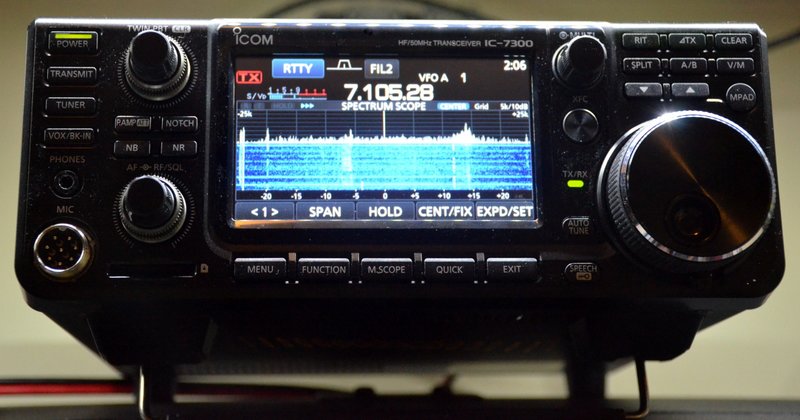
A review of the Icom IC-7300 direct RF sampling transceiver

Icom and ham radio go hand-in-hand, one of their main markets is supplying top of the range equipment, this IC-7300 follows on from the wonderful IC-F7200 (which is a favourite in the office) and sits along side the new range of digital IC-F1000 & 2000 radios that are going really well, but have a new connector type, so new Icom radio earpieces are needed. Read the comprehensive review we found from the swling.com website.


In August 2015 at the Tokyo Hamfair, Icom debuted a new type of transceiver in their product line––one featuring a direct RF sampling receiver. Essentially, it was an SDRtabletop transceiver.


At about the same time that the IC-7300 started shipping around the world, Icom pulled their venerable IC-7200 off the market. Yet the IC-7200 was established as a well-loved product, due to its highly sensitive receiver, its relatively robust front end, and its quality audio. Moreover, it was simple to operate, which made superb as a Field Day or radio club rig.


Therefore, even though the IC-7300 promised much more versatility than the IC-7200, for its price point it had a tough act to follow.


So, of course––even more so than with any other radio Icom has introduced in the past few years––I was eager to get my hands on a IC-7300.  I’m very fortunate that my good friend, Dave Anderson (K4SV) was one of the first purchasers of the IC-7300, and that he didn’t mind (after only having the rig perhaps one week!) allowing me to borrow it for a several weeks for evaluation.


Note:  I should state here that since this rig was loaned to me, I evaluated it based on the firmware version it shipped with, and made no modifications to it.


Icom-IC-7300-FrontThis review primarily focuses on the receiver’s performance, functionality and usability.


Introducing the Icom IC-7300


In recent years, the “big three” ham radio manufacturers have been using color displays, and––Icom most especially––touch screens. While I’m no fan of backlit touch screens in mobile applications, I  think touch screen displays make a lot of sense in a base radio. If carefully designed, a touch screen can save an operator from heavily-buried menus and decrease the number of multi-function buttons on the front panel.


The challenge, of course, is making a display with intuitive controls, and one that is large enough, and with sufficient resolution, to be useful to the operator. In the past, I’ve been disappointed by many displays; the most successful have been incorporated in DX/Contest-class (i.e., pricier) transceivers, meanwhile, entry-level and mid-priced transceiver displays often seem half-baked. While the graphics may be crisp, spectrum displays at this price point are often too compressed to be useful, and if not a touch display, force the user to pause operation in order to find the correct knob or button to change settings. In such cases, I find myself wondering why the manufacturer went to the expense of a color display at all––?


Icom-IC-7300-Display


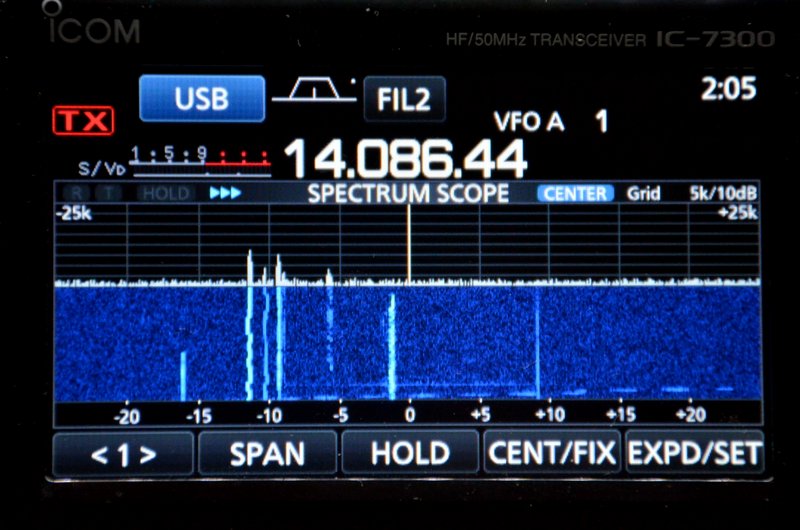
But what about the C-7300 display?  I’m thoroughly pleased to report that Icom did afantasticjob of balancing utility and function in design of the IC-7300’s color touch display and front panel. There are  number of ways you can chose to display and arrange elements on the screen–since I’m an SDR fan, I typically chose a display setting which gave the waterfall the most real estate. Of course, one can chose to give the frequency display priority or a number of other arrangements.


User interface


I can tell that Icom built upon their experience with the IC-7100––their first entry-level touch screen display transceiver.


I was able to get the IC-7300 on the air in very little time. Within five minutes of turning on the IC-7300, I was able to:


  • change the display to feature a spectrum waterfall;

  • change the span of the waterfall display;

  • adjust the TX power output;

  • change the filters selection and the transmit mode;

  • change bands and make direct-frequency entries;

  • adjust notch, passband, and filter width;

  • adjust AF and RF gain;

  • set A/B VFOs and operate split;

  • change AGC settings;

  • turn on Noise Reduction/Noise Blanker, and

  • adjust compression.

Basically, I found that all the essential functions are clearly laid out, accessible, and highly functional.  Impressive.


The IC-7300 ships with a manual–– aptly titled, the “Basic” manual––and a CD with the full and unabridged operations manual.  The Basic Manual covers a great deal a lot more than the manual which accompanied the Icom ID-51a. If you read through the manual, you’ll readily familiarize yourself with most of the IC-7300’s higher function operations, and especially, you’ll be able to adjust the settings to your operation style. The Manual is written in simple language, and includes a lot of diagrams and graphics.


If you’re like me, you will find you’ll also need to reference that unabridged manual, so hang on to the CD, too.


Still, I imagine there’s a large percentage of future IC-7300 owners that will never need to reference the manual––especially if they don’t care about tweaking band edges or similar settings. Yes, believe it or not, it’s that easy to use.


Operation


Icom-IC-7300-Function-Buttons


While I spent a great deal of time listening to CW and SSB in various band conditions and at various times of day, I spent less time on the air transmitting.


With that said, all of my transmitting time was in CW since the IC-7300 mic was accidentally left out when my friend loaned me the rig.


I’m please to report that CW operation is quite pleasant. All of the adjustments––RF Power, Key Speed, and CW Pitch––can be quickly modified using the multi-function knob. While in CW mode, you can also toggle full break-in mode, which is quite smooth, via the function button and touch screen.


SSB functions are similar. While in  SSB mode, the multi-function knob allows you to change the tx power, mic gain, and monitor level. The function button opens an on-screen menu with VOX, compression, TBW, and the monitor toggle.


Here’s a short video I made with my phone while I made a few adjustments to the IC-7300:


Of course, my smartphones’s microphone can’t accurately reproduce the audio from the IC-7300, but you probably get the idea.


The only annoyance I noted––and perhaps I’m more sensitive to this, being primarily a QRPer––is that the 7300’s cooling fan starts up each time you key up. It even comes on when transmit power is at its lowest setting. I find this a little distracting in CW.  Fortunately, however, the 7300’s fan is fairly quiet and operates smoothly.


Receiver performance and reader survey results


Since our radio comparison shoot-outs have been particularly popular (and useful; check out our shoot-out between top portables, and ultra-compact radios, and others), I decided it would make sense to invite our informed readership to evaluate the Icom IC-7300’s performance in a series of blind, informal tests. (For information about these surveys,please read the first survey.)


Below, I’ve matched the labels (Radio A/Radio B) with the radio models.  I’ve also included pie charts which show the results from the survey.


Icom IC-7300 vs. WinRadio Excalibur


Weak Signal CW (40 meter band)


CW


Based on listener comments, those of you who preferred the ‘7300 did so because the CW was more interpretable and stable.


Some of you noted that I didn’t quite have CW at the same pitch on both rigs. I believe this is because the IC-7300’s calibration was ever so slightly off. This has since been addressed.


Weak/Strong SSB QSO (40 meter band)


SSB


This result was almost tied. The Excalibur’s audio––without any adjustments––has a fuller and “bassier” sound. The ‘7300 can be adjusted to have similar characteristics, but the default EQ settings produce very flat audio. Many of you commented that the IC-7300 more faithfully produced audio optimized for SSB.


Shortwave Broadcast recordings


The following recordings were made on the 31 meter broadcast band in the evening. Both radios had the same filter width: 9 kHz and 8.2 kHz.


Weak Shortwave AM (Radio Bandeirantes 31 meter band)


Weak-SW-AM


There was a noticeable preference for the WinRadio Excalibur in this particular audio set. Even though the Excalibur’s audio splattered a bit, the content was more interpretable. The IC-7300’s audio sounded flat in comparison––again, something that can be adjusted quite easily in the ‘7300’s audio settings.


Strong Shortwave AM (Radio Romania International, French 31 Meter Band)


Strong-SW-AM


Once again, the Excalibur won favor, but I imagine results would have been closer had I adjusted the ‘7300’s audio EQ.


Mediumwave Broadcast recordings


Note that the following mediumwave recordings were made during the morning hours (grayline). The strong station is the closest AM broadcaster to my home; it’s not a blow-torch “Class A” type station, merely the closest local broadcaster.


In the “weak” sample, I tuned to 630 kHz where multiple broadcasters could be heard on frequency, but one was dominant.


Both radios are set to a filter width of 9.0 kHz.


Strong Mediumwave AM (1010 kHz)


Strong-MW-AM


Two out of three listeners preferred the Excalibur in this example.


Weak Mediumwave AM (630 kHz)


Weak-MW-AM


In this particular example, the IC-7300 could not pull the strongest broadcaster out of the pile as well as the WinRadio Excalibur. In fairness, the Excalibur was using AM sync detection, something the IC-7300 lacks.


Icom IC-7300 vs. Elecraft KX3


IMG_20160424_105444629


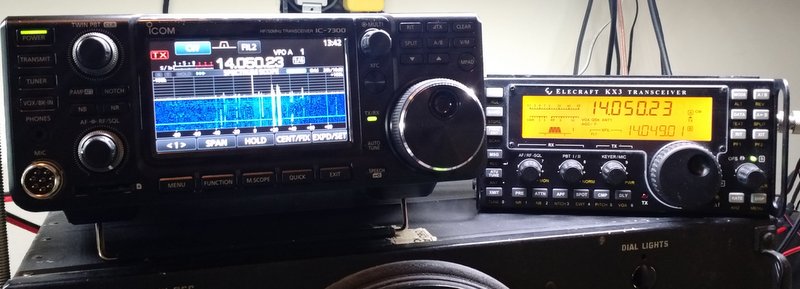
I also decided to pit the IC-7300 against my well-loved Elecraft KX3.


Audio Clip 1: CW (20 meter band)


Elecraft KX3: Radio A


Elecraft - CW


Based on comments, readers who preferred the IC-7300 felt the CW sounded more pleasant and stable.


Audio Clip 2: Weak Signal CW (20 meter band)


Elecraft - WeakCW


Your comments indicated that the CW seemed to “pop out” of the noise slightly better with the IC-7300.


Audio Clip 3: Weak/Strong SSB


(Sable Island working Asia/Pacific on 20 meter band)


Elecraft SSB


These results were spilt in the middle. Again, I believe this comes down to personal preference in the audio. And again––in both radios––the audio EQ can be adjusted to suit the operator.


Receiver performance summary


I enjoy producing audio clips for readers to compare and comment upon. Each time I’ve done so in the past, I’ve had listeners argue the virtues of a particular audio clip while others have the complete opposite reaction to that same clip. Not all of us prefer our audio served up in the same way. No doubt, there’s a great deal of subjectivity in this sort of test.


I’ve had the IC-7300 on the air every day since I took possession of it. I’ve listened to SSB, CW, and lots of AM/SW broadcasters.


And here’s my summary: the IC-7300 is an excellent receiver. It has a low noise floor, superb sensitivity and excellent selectivity. I even slightly prefer its audio to that of my Elecraft KX3, and I’m a huge fan of the little KX3.


I’ve written before about how difficult it is to compare SDRs; the problem is that there are so many ways to tweak your audio, filters, AGC, noise reduction, etc. that it’s hard to compare apples with apples.


In the audio samples above, the IC-7300 and WinRadio Excalibur were both set to their default audio settings. In SSB and CW, the IC-7300 excels, in my opinion. CW seems to pop out of the noise better and SSB is more pleasant and interpretable. The Excalibur has a better audio profile for AM broadcasters, though. Its default audio simply sounds fuller–more robust.


The audio from the IC-7300 on AM sounded absolutely flat. However, if I tweak the audio of the ‘7300, adding more bass, it instantly sounds more like a dedicated tabletop receiver.


I should also mention that while the IC-7300’s built-in digital recording is a fantastic and effective feature, it doesn’t produce audio true to what’s heard through headphones live. This is especially the case when you add more bass and treble response as in the RRI example above. When the audio EQ is set to a default flat, it’s quite accurate.


To be clear:  for broadcast listening, I’ll still reach for my SDRs (the Excalibur, FDM-S2,TitanSDRand CR-1a).


If, however, I have limited space and/or budget for multiple receivers, I’d be quite happy using the IC-7300 as a broadcast receiver on the HF bands.


Speaking from the Shortwave Radio Listener (SWL) perspective, meanwhile, am I pleased with how the ‘7300 handles the broadcast bands?  Most definitely.


And as a ham radio operator, am I pleased with the IC-7300’s receiver––?  Absolutely.


In short:  the IC-7300 seems to have some of the best all-around receiver qualities of any transceiver I know under $2,000.


Summary


Every radio has its pros and cons. When I begin a review of a radio, I take notes of my initial impressions. Here’s my list for the IC-7300:


Pros


  • Excellent sensitivity and selectivity

  • Excellent, highly-customizable RX and TX audio

  • Color touch screen interface

  • Spectrum display is large enough to be useful

  • Intuitive functions

  • Twin PBT is both intuitive to operate and effective

  • Effective RF gain to compensate for noisy band conditions

  • Built-in RX and TX recording, file transfers via common SD card

  • Front panel knobs and buttons are spaced appropriately and easy to use

  • Quiet cooling fan (see con)

  • Decodes RTTY on screen

  • Built-in ATU

  • Antenna analyzer function (not tested)

Cons


  • Lacks secondary receive antenna jack on rear panel

  • Cooling fan immediately starts up on CW/SSB transmit at any power setting (see pro regarding fan noise)

  • Occasionally you may get lost in deeper customized functions

  • Supplied printed basic owner’s manual, while well-written, doesn’t fully cover the IC-7300s functions and options; you must explore the digital owner’s manual in supplied CD.

Conclusion


In a nutshell: Icom has hit a home run with the IC-7300.  If I didn’t already have an Elecraft KX3 and K2, I would buy the IC-7300 without hesitation.


Though the price point is a little high for an “entry level transceiver,” it’s worth every penny, in my opinion. For $1500 US, you get a fantastic general-coverage transceiver with an intuitive interface, nearly every function you can imagine, and performance that would please even a seasoned DXer.


Though I haven’t done and A/B comparison with the IC-7200, I imagine the IC-7300 would prevail in a test. The IC-7300 would certainly wipe the floor with it’s more economical brother, the IC-718.


Radio clubs, take note:


In my view, the IC-7300 has the makings of an excellent radio club rig in which performance, functionality, as well as ease of use are important. I expect that the IC-7300 will not only cope very well with crowded and crazy Field Day conditions, but it will also give any newcomers to the hobby a little experience with a proper modern transceiver. The fact that you can view signals so easily on the spectrum display means that it will be easier to chase contacts and monitor bands as they open and close. Indeed, what better way to mentor a newly-minted ham in modes, contacts, carriers, QRN, QRM, and so forth, than to simply point these out on the IC-7300’s bright, clear display––?


If your club is considering a transceiver upgrade or purchase, do seriously consider the IC-7300. I think you’ll find this rig is up to the task.


And for home? The Icom IC-7300 may be all of the rig you’ll ever need.